
Imagine spending weeks bringing your brand’s latest marketing campaign to life. You strategize the messaging, create assets, launch ads, and hope ROI is high. But visibility goes dark the second leads change hands, leaving you to wonder whether your efforts were worth the investment.
Too many brands experience a disconnect between sales and marketing, resulting in missed revenue opportunities. But with closed-loop analytics, you can ensure both teams talk to one another and benefit from shared data, helping your brand better optimize future marketing efforts.
What is closed-loop analytics?
Closed-loop analytics is a marketing strategy where brands assess leads by tracking their path to purchase from the first site visit to the moment they become a customer. This process “closes the loop” between marketing and sales, connecting data from both teams and attributing leads to specific marketing efforts.
As a result, brands can better measure the value of their campaigns and use these insights to improve performance and inform future campaigns.
How does closed-loop reporting work?
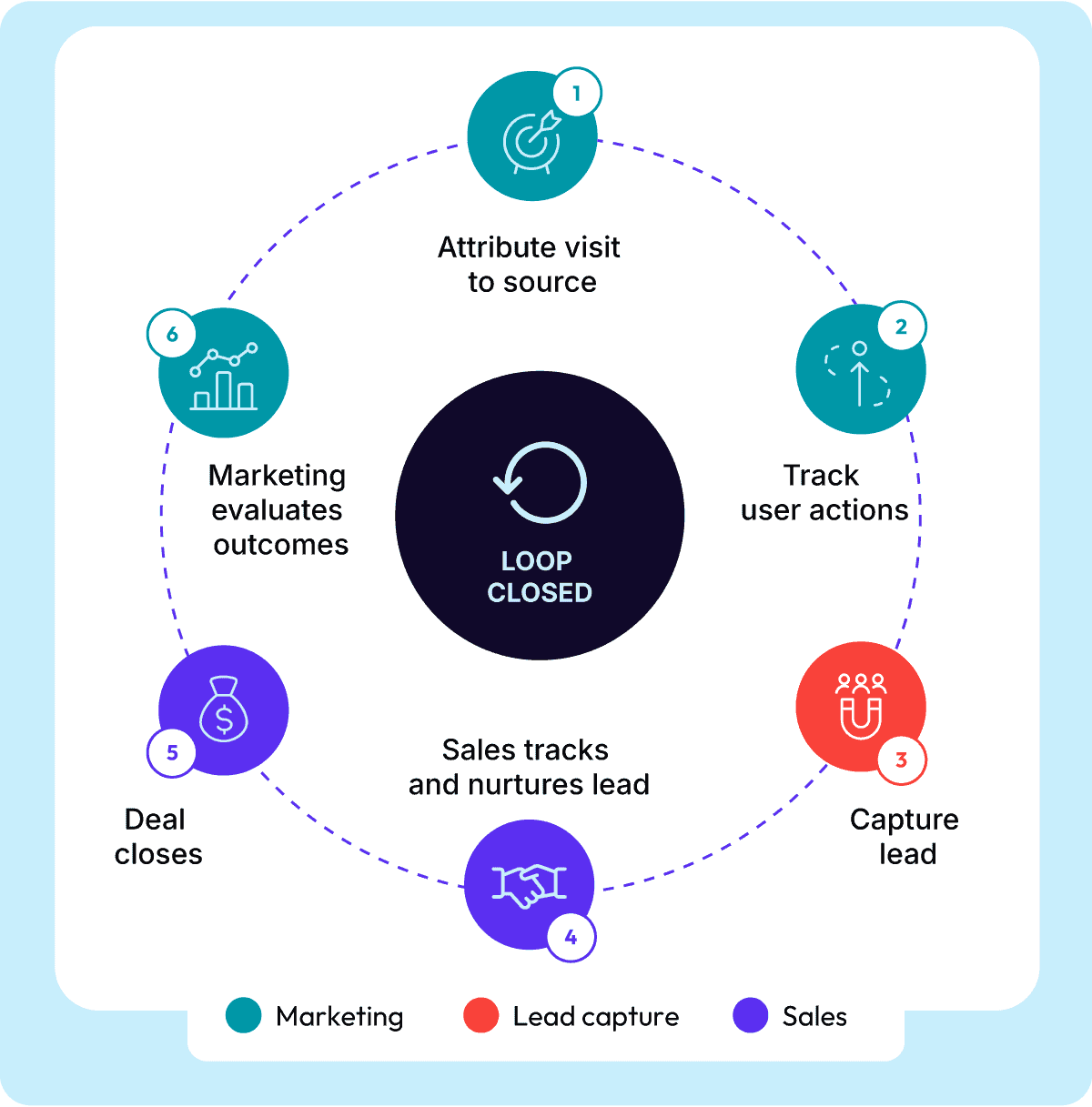
There are six primary stages of closed-loop marketing analytics that occur after a user visits your website:
- Lead source is attributed: When traffic hits your website, use audience-tracking tools to determine what channel sent them there, such as a UTM, email campaign, or organic search.
- User’s actions are tracked: Your software should then track the visitor’s journey across your website, including what pages they visit, in what order, and how much time they spend on each page. These insights can help you determine what content is most valuable to the consumer and accelerate the conversion.
- Cookies or a form fill captures the lead: The lead is captured when the user fills out a form or accepts cookies on your website. This lead is then sent to your sales team or directly to your CRM.
- Sales team tracks lead status: Your sales reps will nurture the lead through the sales funnel, tracking interactions, opportunities, conversions, and deal amount.
- Lead closes and is attributed to original source: Once the lead closes — whether the deal is won or lost — the result gets credited to the original lead source, along with the deal value and time to close.
- Marketing team evaluates outcomes: The marketing team reviews the data acquired in the previous step, gaining insight into which marketing tactics produced profitable leads and which didn’t to inform future campaigns.
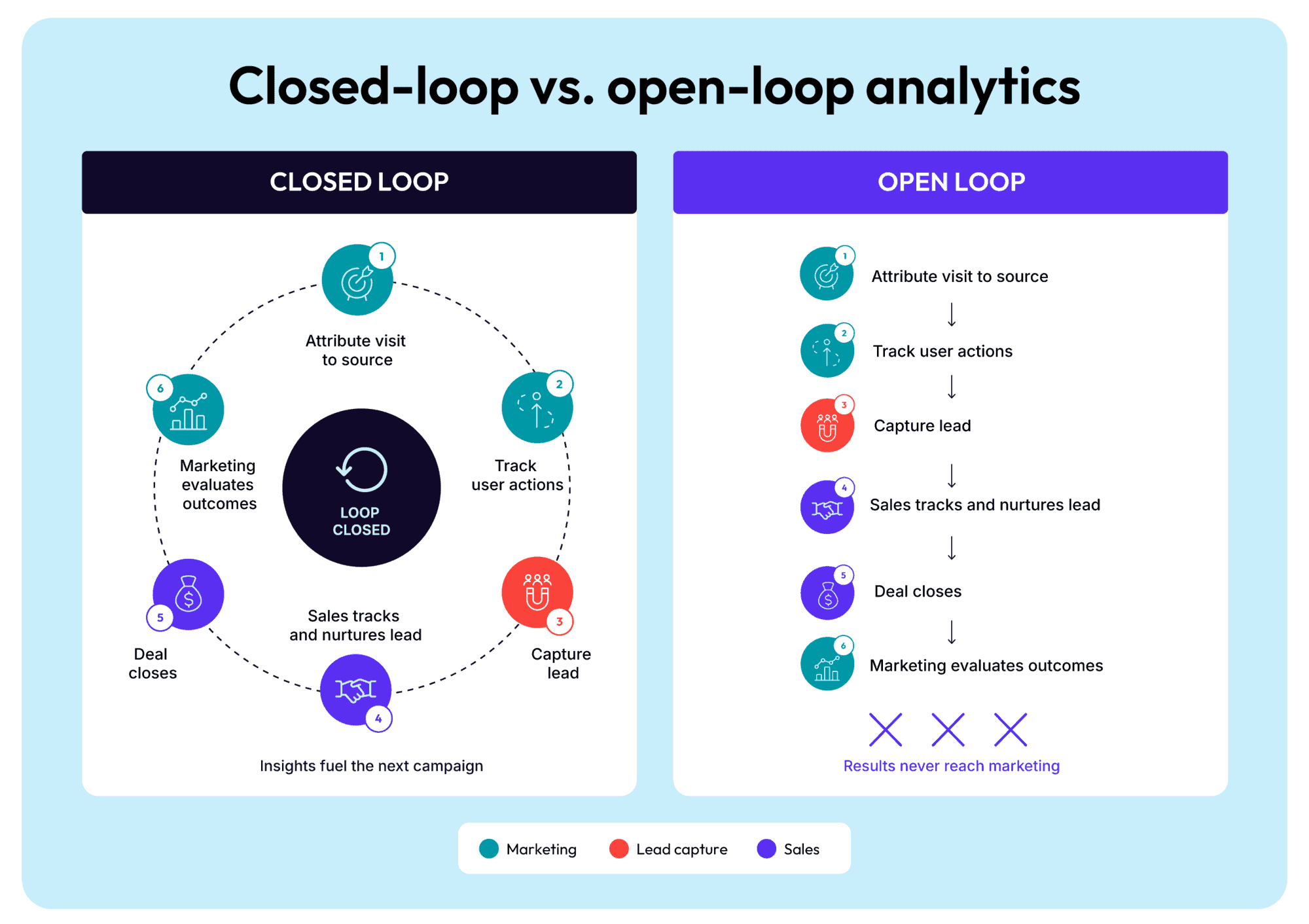
Closed-loop vs. open-loop analytics
Open-loop analytics fail to connect marketing and sales data. Unlike closed-loop marketing analytics, the open-loop analytics process ends when the deal closes. Because the marketing team doesn’t get access to sales data in an open-loop process, they never learn which marketing tactics produced valuable leads.
As a result, marketing campaigns remain unoptimized, and major revenue growth opportunities are lost.
Benefits of using closed-loop analytics in marketing
There are many advantages to implementing closed-loop reporting into your marketing campaigns, such as:
- Revenue attribution: Closed-loop analytics help you connect marketing efforts to revenue impact.
- Data-driven decision-making: By gaining insight into which marketing tactics attracted the most profitable leads, you can better optimize campaigns moving forward.
- Ensuring sales and marketing alignment: Closed-loop reporting bridges the gap between sales and marketing efforts, providing both teams with a shared understanding of campaign performance.
- Optimizing marketing spend: With the insights you gain from closed-loop analytics, you can focus your marketing budget on the most high-yield investments.
- Greater visibility into the customer journey: Closed-loop marketing analytics allow you to see the outcomes of your marketing as they generate leads and those leads become customers.
Best practices for incorporating closed-loop analytics into your channel marketing
Consider the following tips when leveraging a closed-loop system in your marketing analytics to drive the greatest outcomes for your brand.
Begin with owned touchpoints
Analytics begins with measurement you can trust. That means leveraging your owned touchpoints first. Owned touchpoints include any platform your brand directly controls, such as your brand’s:
- Website
- Mobile app
- Campaign landing pages
- Loyalty and services portals
- Channel partner platform
- eCommerce store
When you make your owned touchpoints the source of truth for your analytics, such as conversions, partner engagement, and customer identity signals, you can trust that you have control over your data measurement.
Integrate data sources
Closed-loop analytics relies on data accuracy. Be sure to integrate all data sources to create a centralized source of truth. This includes technology like your CRM, marketing automation platforms, and analytics software. With all data integrated into a single location, you can better avoid silos, errors, and duplicate data.
Define key terms
When data flows through two different teams, it’s crucial that both teams have a shared understanding of what this data actually means. That’s why it’s necessary to establish agreed-upon definitions for key terms, such as:
- Leads
- Conversions
- Sales qualified leads
- Marketing qualified leads
- Prospects
- Customers
Failing to clearly define these terms creates a disconnect between teams, increasing the likelihood of inaccurate reporting and conclusions. When you land on a shared definition of these terms, you ensure everyone is on the same page when interpreting results and sharing them with partners and stakeholders.
Once you’ve clarified these terms, it’s important to communicate them across your channel partner network to ensure your partners are also operating on the same definitions.
Establish your brand’s normal
Once you understand the data you’re tracking, it’s vital to establish what results are normal for your brand. In other words, what factors typically cause your numbers to shift, and at what point is that variation acceptable?
For example, if you typically experience a significant drop in sales at the end of Q1, it’s important to communicate this trend with the rest of your team and partners. Otherwise, this seasonal dip will be inaccurately flagged as a major concern.
Establishing normal data shifts also helps teams set realistic benchmarks, identify true behavioral anomalies, and determine the cause of these unexpected outcomes.
Assess and optimize regularly
As with any campaign, tactic, or strategy, you should evaluate your performance data regularly to identify important trends, double down on what’s working, and pull back on what’s not. Results change frequently, and so should your assessments. Regularly reviewing data helps you stay up to date on the most current analytics and adjust your campaigns accordingly to ensure the best outcomes.
Leverage closed-loop analytics in your marketing
Gain insights from visit to close with a robust closed-loop analytics strategy. With data science and insights services from Ansira, you can leverage the knowledge of marketing experts to turn data into decisions and insights into action.
Contact us to learn more about AnsiraX marketing and consulting services.